
Maximizing Surface Area for Luck (Weeks 4-8, London)
Understanding 'haunted houses' and why talking openly about our digital lives might be a seed for better social technologies

Hello from the Center of Time,
For the past three weeks, I've been living in Greenwich, the G in GMT, where the prime meridian splits the western and eastern hemispheres. Nearly every other day I've been running across that invisible line decided on by a handful of men in 1884.
I've covered more than 250 miles on foot since I last wrote here four weeks ago. Slow runs, coffee meetings, wandering through parks, sprinting to catch trains. I've discovered that LinkedIn has QR code functionality that serves as something of a networking status symbol at conferences. I've come to enjoy the ritual of sitting on the upper floor of buses, listening for tree branches scraping overhead. And I'm scheming ways to catch My Neighbor Totoro in theatre once more—one of the most magical performances I've ever experienced.
It's been a time to observe patterns: how people talk (or don't talk) about their digital lives, how tech optimism and cynicism can coexist in the same room, how we all seem to sense something's fundamentally wrong with the pace of this world but keep moving anyway. And why, in the midst of what Cory Doctorow calls the "enshittification" of online platforms, people (at least the ones I’m interacting with) are simultaneously seeking more human-to-human connections and human-to-AI ones.
I've spent time with technologists, physicists, ecologists, musicians, game designers, futurists, AI advocates, and even a Facebook evangelist. It's been an emotional pendulum—swinging between doom and hope, despair and possibility. Everyone has different ideas about what rhythms should govern our digital lives. But what I'm most tired of hearing is the same line repeated like a moral shrug: "If we don't do it, somebody else will."
I. Celebrating in Solitude
Shortly after settling into the house I've been looking after this month, I celebrated my 23rd birthday. Alone. Not in a sad way. It was wonderful, actually.
I've never spent a birthday entirely by myself, and it turned out to be more reflective and quietly celebratory than most I've had in recent memory. I ate Ethiopian food saved from going to waste through Too Good to Go, an app I've grown to love. And I wasn't completely alone: I had Ellie and Daisy, two Maine Coon cats who are some of the coolest domesticated animals I've ever encountered (plus Sofia, a black cat with her own charm). The Maine Coons are like cat-dogs!


I still believe birthdays are better spent with people you love, but I'm grateful for this one. There's a particular rawness to being alone with yourself on a day you're culturally programmed to avoid doing so. It’s a day to stare directly into who you are without the buffer of others.
"The most terrifying thing is to accept oneself completely."
Jung
II. A Trip to Oxford
The day after my birthday, I traveled to Oxford for a film screening. Having never watched Harry Potter, the magic of the town hit me differently. I thought about the great minds these walls have shaped for almost a thousand years. Knowledge is power. And Oxford wrote a lot of the modern playbook.
The screening was for Coded Bias, marking the film's five-year anniversary. It was held in Rhodes Hall, the building for Rhodes Scholars. As soon as I walked in, I noticed a stone carving about South Africa and felt a shiver when I remembered that Rhodesia—what is now Zimbabwe and parts of Zambia—was named after this same Rhodes. I'd spent this past winter in Zimbabwe witnessing the lingering effects of that colonial legacy. Sitting in the hall, paintings of Bill Clinton and Nelson Mandela, both Rhodes Scholars, looked down at me.

The film follows Joy Buolamwini, a Rhodes Scholar herself, who as an MIT Media Lab researcher discovered that facial recognition software couldn't detect her face unless she wore a white mask. She soon uncovered that all of these mainstream softwares consistently misidentified people of color. At the time commercial facial-analysis systems misclassified dark-skinned women at rates as high as 34‑35%, compared to error rates under 1% for light-skinned men. This was due to training data heavily over representing white faces. Joy's activism through her Algorithmic Justice League following this forced change: in 2020, IBM, Microsoft, and Amazon paused or limited facial recognition sales to law enforcement; IBM exited the market entirely. Her work proves that technological biases aren’t just abstract ethics problems—they can also be measurable harms.
But what stayed with me most was Joy's insistence on the simple fact that now, more than ever, story drives change more than research or new products. "Story builds community," she said, "and community creates power."
Her choice to host the screening in Rhodes Hall was deliberate. She explained that the only way to change a legacy like Rhodes' isn't to erase it, but to challenge it in public, in the very spaces that once upheld it. You don't forge new narratives by walking away from old ones. You change them by naming what's wrong and working from within.
Near the end of the panel—which focused on coping with the societal changes and injustices that AI is creating—the person sitting in front of me spent several minutes feeding notes into ChatGPT, crafting a question. My initial reaction was that this seemed a bit ironic. When they finally asked it, it turned out to be one of the most well-received questions of the night, sparking rich discussion. It was a reminder that fully rejecting AI tools simply because aspects of them are harmful isn't the answer. The challenge is learning to use them conscientiously.
The last four weeks have taught me that dismissing these tools as "just another printing press" is naive. The printing press never decided what to print. AI does. It's a superpower already rewriting reality. And every superpower can be wielded for evil. To pretend otherwise is to hand that power to those who won't.
My greater question is whether or not the person in front of me should have disclosed that they used ChatGPT to formulate their question? If they did, does that take away validity?


III. An Evening with an Unnamed AI Company
Later in my birthday week, I attended an event for ex-Google employees hosted by "the most impressive generative AI company you've never heard of." Don't even ask how I got invited.
The setting was a high-rise in London's financial district. Upon entering, I encountered the coolest "floor is water" installation—every footstep creates ripples spreading outward. A little touchpoint into nature's rhythms before being launched to the 10th floor in a wickedly fast elevator where you don't even feel the car rising. The rooms’ energy was strikingly different from the Coded Bias screening. There was delicious catering, IPAs, kombucha, and a whole hour of pre-event networking.
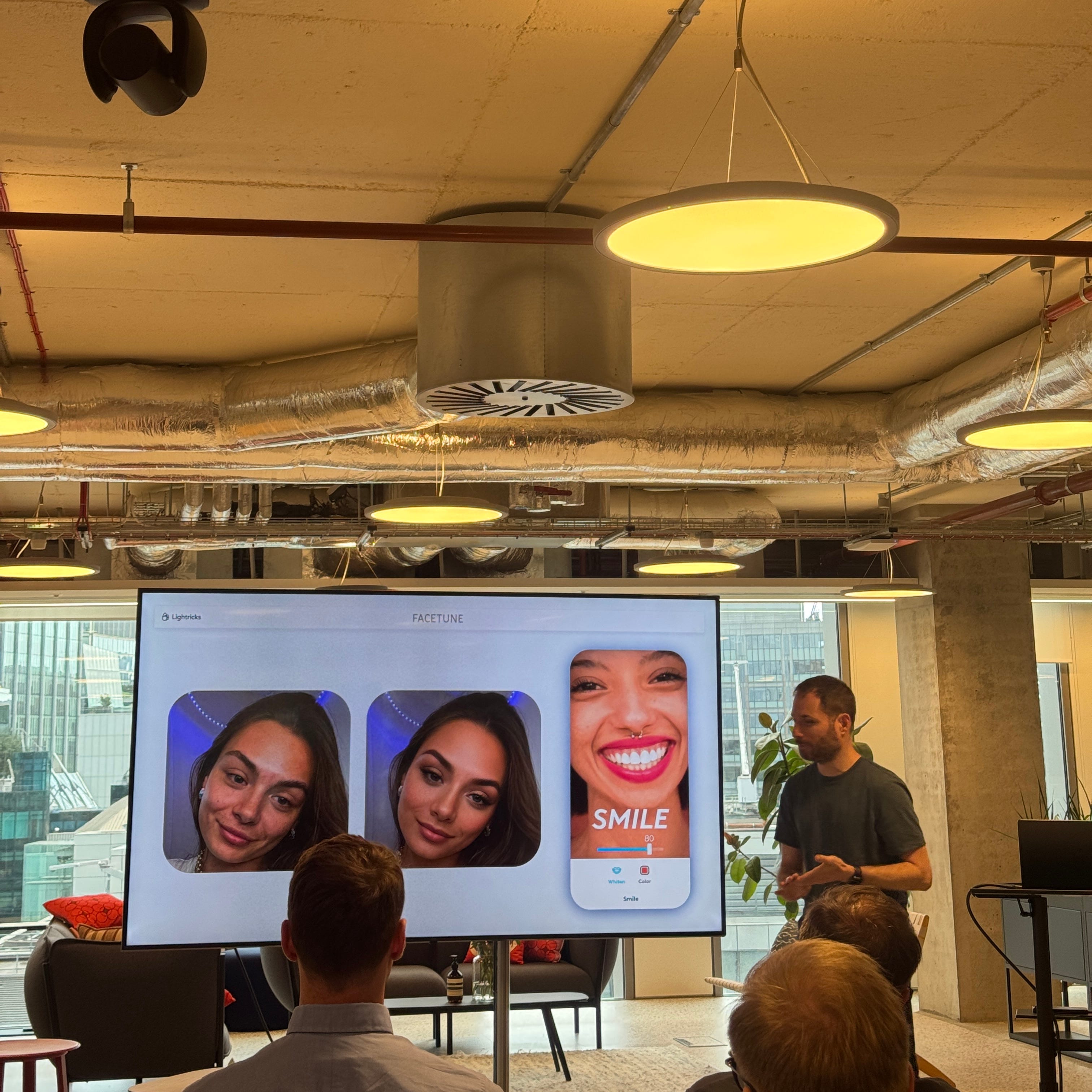
When we sat down, the company's CTO presented their products. From developing leading face-editing software in the 2010s to now preparing to launch some of the most powerful AI video generation tools on the market. The CTO was proud of having made it accessible for people to make their faces and bodies look unrealistic. Now, he was excited to show how the company would make it accessible for anyone to generate nearly any video they could imagine—including turning photos of others into hyperrealistic videos.
During the presentation—through which most ex-Googlers divided their attention between listening and checking LinkedIn—I prepared some questions. Afterward, I approached the CTO directly.
I started with the temporal dimension so central to my Watson exploration. Given that most creative work has historically required time and deliberation, is their design team considering adding any intentional barriers like confirmation prompts or waiting periods to encourage users to think more critically before hitting send? "No. We're marketing this to marketers. Efficiency is everything to them."
What about copyright and training on artists' work? He explained that conceptions of copyright will have to evolve with these technologies. The models are already training. Much like the human mind creates art based on things it has observed and experienced, so does AI. He believes copyright law needs to be rethought in the age of AI. Like Joy, the CTO emphasized that in an era where resources and rules are less constraining to creativity, story will matter more than ever. The best stories will shine through.
He mentioned that when the company first released their face-editing app in the 2010s, France and Norway had policies requiring any commercially retouched photo to be labeled as altered. (These laws are still in effect, though he presented it as if they had been repealed.) Nice in theory, but nearly impossible to enforce. The problem of distinguishing real from fake has been a shared talking point at two tech workshops I've attended recently. It seems to be an increasingly unsolvable problem.
I left the building feeling deflated. AI truly feels like a race to the bottom. If this company cared more about thoughtful development, someone else would simply beat them to market, disappointing investors expecting quick returns.
Right before exiting, a guy I'd spoken with earlier gestured at the “floor is water” installation and exclaimed, "Why do these places spend so much money on stupid shit like this?!"
IV. Finding Generalists!
Explaining what I'm doing on this fellowship is hard. Learning how to adjust the pitch based on who I'm talking to has become a creative practice in itself. Sometimes I say I'm exploring the temporal dimensions of social networks. Other times I describe myself as a digital archaeologist: someone digging through the layers of how we've built our relationships in the digital world to understand what we might be losing or gaining with time.
I wanted to come to London first partly because of the creative community here. I've gotten to spend time with folks at Jason Bruges Studio and Marshmallow Laser Feast—two organizations using digital technologies to reconnect people with deeper rhythms.
Jason Bruges creates responsive installations that make environments come alive: lighting fixtures that breathe with the people in a room or installations that mimic natural phenomena like lightning.
Marshmallow Laser Feast builds immersive experiences that let you see through the eyes of a bat or feel the underground mycelial networks that connect forest ecosystems. It’s technology as a bridge to non-human ways of thinking.
What strikes me about both studios is how they're essentially doing the opposite of what that AI company CTO described. Instead of optimizing for efficiency and instant gratification, they're creating experiences that slow people down, that require presence. It’s a different kind of digital rhythm.
These studios often end up doing corporate work like creating those impressive lobby installations such as the rippling water display I encountered at the AI company. While designing for big corporate clients isn't necessarily their first choice, it's how they fund the more experimental work and, perhaps more importantly, how their ideas about human-technology-nature relationships reach audiences that might need them the most. There's something strategic about making these human-nature-technology connections visible in the very buildings where tech executives make decisions about products that will shape how we relate to each other and the world.
It's been inspiring to exist in these design studios surrounded by people who are the epitome of generalists. They move fluidly between coding interactive systems, photographing the pigmentation of trees over time, researching how mushrooms communicate through networks, and crafting experiences that help others feel their place in these larger living cycles. They're part technologist, part artist, part ecological researcher. Exactly the kind of interdisciplinary thinking that feels necessary for imagining different relationships with our digital worlds.
It feels like a home I never knew existed, where the boundaries between disciplines dissolve in service of deeper questions: How do we create technology that enhances rather than replaces our connection to the living world?


V. A Future of Offline Social Technologies?
My approach this last month has been what I’ve come to think of as maximizing the "surface area for luck." Basically just meeting as many people as possible. It's a skill I have gotten good at over the years. I Love Networking.
The logic is simple: the more you interact with the outside world, the more chances you have to stumble into the right collaborators, friends, and projects. This sort of luck is all about the quantity of connections, even if most interactions don't lead anywhere (and if it's socially exhausting at times).
I think this way of moving through the world is part of what carried me from my background to a year on the Watson Fellowship. But being in London has made me realize how limited my networks have been. In college, most of my relationships grew out of shared activities like mountain biking or skiing and outside of that, they were usually with people who were educated and mostly white. Now I’m spending time with one of the most diverse communities on the planet, and the connections forming here aren’t based on hobbies or credentials. They’re rooted in something deeper, and harder to name.
Lately, I’ve been spending a lot of time with musicians despite the fact that my own musical experience stops at middle school trombone. It’s unfamiliar ground, and I’m still not sure why we keep finding each other. Maybe it’s because creatives feel the dissonance of social technology more acutely. Making something real, something that didn’t exist before, takes time, stillness, and care. The rhythms of today’s platforms are built for the opposite. They rush you. They fragment attention. And for people who live close to the creative process, that tension becomes impossible to ignore.
Today, smartphones are on par with being as ubiquitous as toothbrushes globally. And in the U.S., multiple surveys consistently find that around 30% of people would rather give up sex for a week, or even a year, than lose access to their smartphone. Every day, we spend countless hours immersed in glowing rectangles swiping.
These platforms are what Michael Stevens calls "haunted houses": algorithmic spaces filled with ghostly traces of human presence. Posts, messages, videos—each a fragment of someone’s life, sometimes real, sometimes synthetic, often both. And we sit inside them for hours, surrounded by avatars and echoes, pulled deeper by algorithms designed not to connect us, but to unsettle us just enough to keep scrolling.
But these aren’t true interactions. They’re approximations. Democracies are increasingly shaped by these approximations. TikTok feeds overflow with AI-generated content stitched together from other people’s lives—expressions with no experiencer. The boundary between real and fake isn’t just blurry, it’s evaporating. And when everything persists but nothing sticks, the relevance of truth itself starts to erode.
We are, as Stevens suggests, not just watching ghosts. We’re becoming them. Gliding through feeds, reduced to clicks, likes, and data trails, we’re interacting not with each other but with echoes. And hoping, somehow, they’ll echo back.
The musicians I'm meeting can't stand this reality, and they're not alone. Research shows people are leaving mainstream social platforms in growing numbers. As content becomes less rooted in truth, there's a growing hunger for authentic reality—which explains the resurgence of podcasts and formats that feel more immediate and less mediated.
As journalist Kyle Chayka writes:
"We consumers are suddenly awash in voices and faces chattering at us, each trying to win a slightly larger slice of our dwindling trust as the rest of the information ecosystem is flooded out by AI slop and NSFW chatbots sponsored by Elon Musk."
My time in London has led me to sense that people are growing tired of ghostly traces and instead craving the finite, the unrepeatable. We're entering a moment where mainstream social platforms are too repulsive. I think people are wanting human connection and contact with the natural world in ways algorithms can’t replicate.
I'm increasingly convinced that the future of social technology worth building won't trap us in haunted houses. It could push us back into physical spaces like parks, sidewalks, actual rooms with other people. It could push us back into the slower, reciprocal dances that make us human.
The best social technologies won't be the ones that hold our attention the longest, but the ones that give it back to each other, to the natural world, to presence itself. Technologies not driven by engagement algorithms, but by something more fundamental.
There's definitely resistance to this vision. It gets dismissed as naive idealism by those invested in the status quo. And right now, it's hard to imagine that alternative platforms could ever match the profitability of mainstream social networks. Yet I'm increasingly hopeful. My time in London has shown me that people are ready to rally around these alternatives. What’s needed are new incentive structures, corporate architectures built around connection instead of retention, and great storytelling to build these emerging ecosystems.
Advances in decentralized technologies are becoming more and more viable for this movement. And thanks to gains in AI-assisted development it’s possible to start from scratch with far fewer resources than ever before.
Exploring the organizations at the forefront of this movement is exactly what I’m doing now. It feels like a precarious moment, as the winds around AI seem poised to begin shifting toward optimizing for attention…
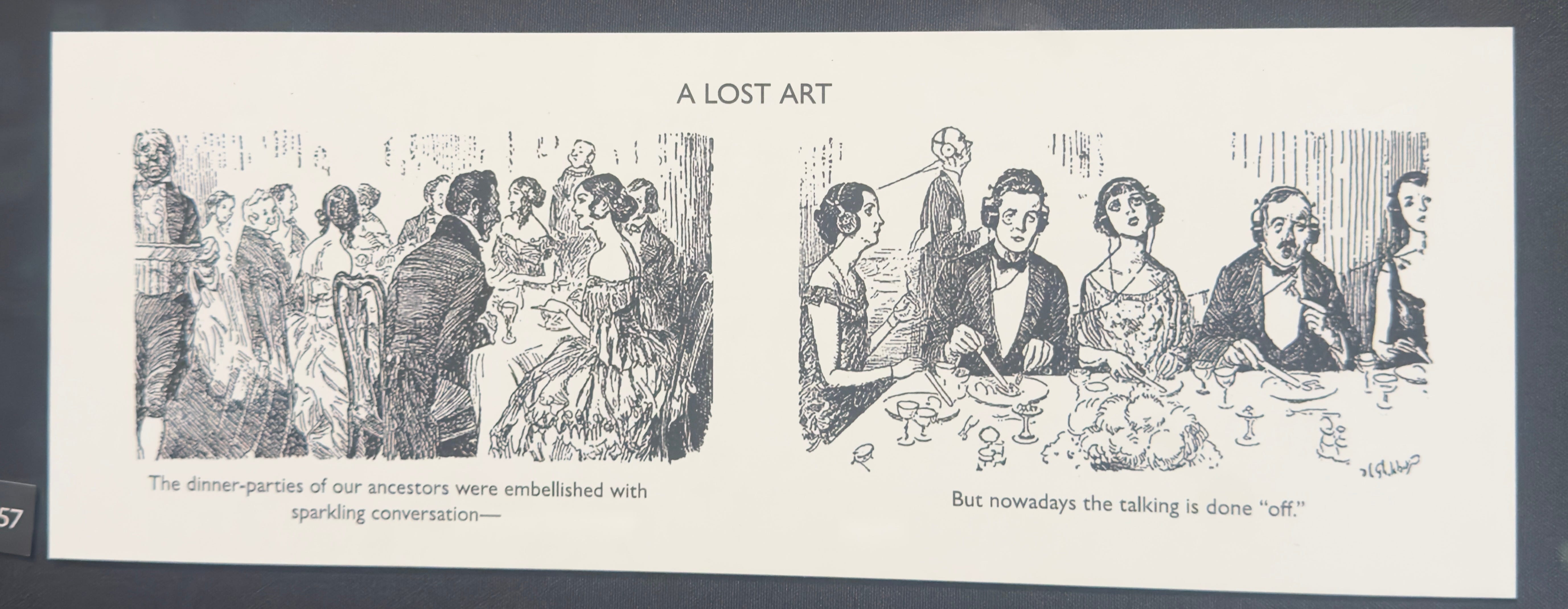
And maybe that’s where maximizing the “surface area for luck” comes back in. This past month, I’ve been applying it to my own life through meeting as many people as I can, saying yes to literally every conversation. And sometimes even asking people about the time they spend in the digital world. It makes a lot of people uncomfortable. Sometimes they squirm, laugh it off, or change the subject. But sometimes they answer with humility, embarrassment, frustration, or conviction, and those conversations seem to crack something open.
If enough of us start talking this way, out loud, honestly, and without judgment, it could create the conditions for something bigger. Future social technologies don’t just have to spawn out of Silicon Valley. They can grow out of cultural norms, out of what we talk about and what we expect from each other. Normalizing these conversations might just be the luck we need: a thousand small, human experiments that, together, spark a movement toward technologies designed not to keep us scrolling, but to bring us back to each other, and back to the world we’re already a part of.
Much love from Greenwich,
Dan
Things I’ve Been Snacking On:
Carless People: The Place I Used to Work by Sarah Wynn-Williams
Nexus: A Brief History of Information Networks to the Stone Age to AI by Yuval Noah Harari
The Dark Forest Anthology of the Internet by Yancey Strickler
Tony’s Chocolonely 70% Dark Chocolate
Purezza’s Dough Balls
Snack a Jacks Salt and Vinegar Rice Cakes


Yeah, I was wondering why podcasts are so popular nowadays and I think you may have hit on it with our seeking of more authentic, unscripted connection. Bravo on this piece. Much to enjoy and ruminate over. I especially liked the comic from the 1930s—what a great way of making the point that we’ve been here before. (Of course, the 1930s ended with Germany’s invasion of Poland…I hope the current cycle ends better but fear it will not.) Anyway, these pieces will be great raw material for a future memoir. But no need to worry about that now. Keep up the good work.